

Board Performance · 2025
In this section13 topics
- Compliance Monitoring — Overview1 item
- Prevention of Conflicts of Interest3 items
- Prevention of the Use of Inside Information3 items
- Anti-Corruption4 items
- Whistleblowing3 items
- Selection of Directors & Chief Executives7 items
- Selection of Independent Directors2 items
- Director Development4 items
- Evaluation of Board & Subcommittee Performance3 items
- Subcommittees1 item
- Meeting Attendance & Remuneration6 items
- Supervision of Subsidiaries & Associated Companies5 items
- Audit Committee Duty Performance1 item
Compliance Monitoring — Overview
Monitoring of Compliance with Other CG Policies & Guidelines
Report on Key Operating Results on Corporate Governance
In 2025, the Company complied with the principles of good corporate governance of listed companies, which can be summarized as follows:
Principle 1: Establish Clear Leadership Role and Responsibilities of the Board
All the directors and executives accept their roles as leaders of the organization and perform their duties responsibly, carefully and with integrity and act as role models all executives and employees.
The Board of Directors approves all matters of significance relating to policy, vision, corporate strategy, goals, business plans, financial targets and yearly budgets. Additionally, overseeing efficient allocation and supervising the management to be in accordance with the policy with efficiency and effectiveness. As well as driving the organization to adapt to various changing factors in order to maximize the economic value of the business and the highest stability for the shareholders.
The Company segregates the roles, duties and responsibilities of the Board of Directors, the Board Chairman, Managing Director and the management and discloses these on corporate governance policy, annual report and the Company’s website.
The Board of Directors is firm in its belief that business should be conducted under strict rules of corporate governance and sustainable development by publishing its corporate governance policy, codes of conduct and ethics, anticorruption policies and measures, and other CG related policies. All these standards of corporate behavior are communicated to all executives, employees and stakeholders requiring their acceptance and adherence and monitored through an annual compliance audit.
The Board of Directors is aware of the importance of operating the business ethically and in a socially and environmentally responsible manner whilst seeking favorable returns and sustainable growth. The Company also seeks innovative ideas to create added value for all stakeholders and is always ready to adapt to change and compete successfully.
Principle 2: Define Objectives that Promote Sustainable Value Creation
The Company clearly defines and communicates its corporate goals and objectives to all employees and strengthen the vision and values to reflect in the decisions and operations of employees at all levels to become a corporate culture.
The Company promotes innovation and technology based functions to control costs, increase distribution channels, develop products and supervising the efficient management of resources, supervising the operations to be appropriate, and following up the operations in accordance with the strategy and plans.
Principle 3: Strengthen Board Effectiveness
Structures, roles and duties of the Board of Directors and sub-committees
The Board of Directors comprises 8 members considered appropriate for the size of the Company. The balance between executive and nonexecutive directors is also considered appropriate and the number and qualifications of independent directors are complied with the SEC’s requirements
The Board Chairman and Managing Director are not the same person, and their roles and duties are clearly divided to ensure a balance of responsibility between them.
The Board of Directors has appointed subcommittees to assist in enhancing its efficiency and overseeing the Company’s operation, consisting of four subcommittees, which are the Audit Committee, the Nomination and Remuneration Committee, the Investment Committee, and the Enterprise Risk Management Committee. Their duties and responsibilities are clearly defined.
The Nomination and Remuneration Committee holds a meeting to set out the criteria and process of director nomination and appointment to ensure the candidates have the required qualifications, knowledge and expertise, and then recommends the candidates to the Board of Directors for appointment or approval, as the case may be, before proposing to the shareholders’ meeting for further consideration on the director appointment.
All directors understand their role and duty to report their holding of other positions and shall report to the Company at the end of each year and/r when there is any change during the year.
All board members have work experience or held senior from various professions that are necessary for the management of the company's business which composing of people with knowledge or experience in the insurance industry especially in life insurance, accounting, finance, legal, and risk that can suitably cover all the company's business strategy and goals. As such, the Board of Directors are currently composed of expert with skills and experiences. The Company has procedure for a nomination and appointment process of all the director’s position.
Principle 4: Ensure Effective CEO and People Management
Nomination of senior executives
The Board of Directors attaches importance to the nomination and development of senior executives to ensure they have the knowledge and competency to be effective managers. The Company has appropriate criteria for executive selection.
Succession Plan
The remuneration and nominating committee has a plan to recruit personnel who will be responsible for important administrative positions. The nomination of the president and senior executives is in accordance with the nomination procedures from both inside and outside the organization. The importance is divided into two categories: 1) important positions that have a high impact if there is no successor (Critical Position) and 2) important positions in strategic (Strategic Position). All of these positions have a systematic succession planning process and clear procedures.
For selecting a person in the organization, this will consider the most appropriate personnel from the successors who are assessed as potential. Such person will receive skill development to be available to serve an importance position in case of vacancy, end of service term, or others. In the case of being appointed, relocating, resigning or vacating from the position after the employment period or any other reason causing that position to be vacant
Thus, the procedures in nominating the president and senior executives are in consideration of qualifications, expertise, skills, knowledge, moral personality, and experience of type of business related to Company. Such procedures will be systematically organized in all levels of positions appropriately and transparently in order to ensure that the Company is empowered by qualified.
Development of executives and employees
The company is committed to developing Empathetic Leaders, with empathy as the foundation of the corporate culture, to cultivate Engaging Leaders who can effectively motivate and strengthen employee commitment. The primary objective of leadership development at all levels is to enhance employee engagement in both work and organizational aspects, ensuring that employees remain dedicated, motivated, and driven to achieve their responsibilities efficiently—which directly contributes to the organization's success. The company is focused on developing leaders as People Leaders, who prioritize employee management and development. Empathy serves as the core principle in fostering a workplace culture centered on understanding, collaboration, and mutual care, enabling employees to work happily while staying aligned with organizational goals. To implement this approach effectively, the company has developed and promoted Engagement Practices that leaders can practically apply. These practices help elevate employee engagement levels within each unit to the Highly Engaged Zone, with Empathy as the foundation for creating a workplace where employees feel valued, supported, and empowered to grow alongside the organization.
Principle 5: Nurture Innovation and Responsible Business
Promotion of innovation
The Company encourages innovation in all of its work units with respect to product development, marketing, distribution channel, business process and technology so as to ensure more efficient and more effective results and enable the Company to create and maintain a sustainable competitive advantage.
As regards organizational management and sustainability, the Company attaches importance to efficient management of both internal and external resources. The Board of Directors considers and approves plans and budgets for all resources required by the Company to enable the Company to achieve the corporate goals and objectives on a sustainable basis, and also oversees and ensures that the IT risk management and the policy and measures for IT system security are in place.
Responsible business operation
Although its reinsurance business has no direct impact on the environment, the Company still advocates a business operation that is socially and environmentally responsible and does not infringe upon stakeholders’ rights in seeking sustainable achievement of objectives.
1. Non-violation of human rights
The Company recognizes its responsibility to all groups of stakeholders such as shareholders, investors, employees, customers, business partners, competitors, creditors and others including communities, society and the environment in a bid to retain their sustainable mutual interests by paying attention to rights of those stakeholders according with the laws and obligations of the Company. The Company will not perform any act that infringes upon rights of stakeholders. The Board of Directors has a policy on human rights for adherence by all executives and employees. The Company’s code of conduct and ethics sets out the standards of behavior to ensure that stakeholder’s rights are fully observed. Any stakeholder damaged by a failure of the Company to observe such rights can expect fair and proper compensation for any damage suffered. More details of the policy on human rights are available at the Company’s website under the topic of “Corporate Governance.”
2. Treatment of stakeholders
The Company has formulated a guideline on treatment of each group of stakeholders for all directors, executives and employees to adhere to, the details of which are as follows:
Treatment of shareholders
Apart from the basic shareholder rights established by law and the Company’s Articles of Association such as a right to attend the shareholders’ meeting, right to vote, right to express opinion freely at the shareholders’ meeting, and right to earn a fair return, the Company also provides additional protection to shareholders rights as follows:
Ensure that the shareholders are provided with full disclosure of all information both financial and nonfinancial accurately, correctly and simultaneously through the Stock Exchange of Thailand’s electronic media, the Company’s website, and all other forms of media.
Encourage shareholders to exercise their right to attend shareholders meetings, their right to vote and other rights to which they are entitled, and not perform any act that violates or prejudices shareholders’ rights.
Permits shareholders the right to make suggestions or lodge a complaint regarding the Company’s business operation through channels indicated on the Company’s website. The company will ensure that all suggestions or complaints are screened and considered by the Board of Directors or the concerned parties and the outcome of such advised to shareholders. In 2025, there were no suggestions or complaints filed. Telephone calls and email were made to Investor Relations asking for information about the Company’s business operations.
Providing Investor Relations to provide information and answer questions from shareholders. So that the shareholders receive the information they need to be accurate, complete, sufficient, timely, reliable, and equally.
Treatment of employees
Employees hold the key to a successful reinsurance and insurance-based enterprise. The Company seeks to encourage its employees to have pride in their work and be keen to advance their careers. The Company therefore attaches priority to staff development, fair treatment of all employees and provision of compensation compares favorably within the insurance industry. The Company also ensures employees’ wellbeing through a modern and comfortable workplace environment. Employees are also provided with health benefits and recreational activities. The details are as follows:
All employees are accorded treatment following human rights principles with dignity, equality and without violation or infringement of any other rights.
Employees at all levels are properly selected through a fair and transparent recruitment process, based on the required qualifications for each position, educational background, work experience and other requirements without discrimination based on sex, age, nationality, religious or any other status unrelated to job requirements.
The Company considers health and safety at work to be an essential part of employee treatment. A safety, occupational health and workplace environment committee ensures that all aspects of workplace health and safety are properly considered. The Company also fosters a pleasant work environment for employees and provides safety and convenience for customers, business partners and stakeholders when visiting the Company. A disaster recovery plan has been formulated in the event of fire or another emergency and the plan execution is practiced annually. All equipment is inspected, maintained and repaired to always remain functional. In 2025, there was no report of any employee accident or sickness at work. The Company has incorporated the best practice for safety into its code of conduct and ethics.
A welfare committee has been set up as an employee representative to work with the management in improving employee welfare and to arrange activities for employee participation such as New Year’s activities and other off premises events.
The Company provides its employees with preemployment checkups and annual health checkups according to age groups. For health promotion among employees, the Company makes available standard and by arranging exercise activities such as yoga, etc. in order to encourage exercise and have the opportunity to meet with employees from different departments in the same company. By confident that if the personnel in the organization have good health will help reduce illness and ultimately improve work efficiency.
Under the Company’s policy and procedure for remuneration and welfare, employee compensation is set out at an appropriate level that is commensurate with their duties and responsibilities and competitive with the comparable positions in similar businesses. The employee compensation is decided based on salary and compensation surveys in insurance business and other industries derived from various sources together with the individual employees’ yearly performance evaluation. The Company has also established an employee provident fund which gives employees the rights to receive employer’s contribution and benefit thereof from the Company based on the required years of service specified by the Company so that they will have accumulated savings for their future needs.
The Company has established a human resource development policy, encouraging consistent employee training and competency development to enhance skills and helping employees advance their careers. Recognizing that employees are the most valued asset of the organization, the Company makes certain that all employees will be developed in accordance with the Training Road Map, according to their Career path and Career plan.
Employees are encouraged to access information through channels such as the Company’s Intranet, internal announcements or emails promoting clear and open communication between the Company and employees enhancing efficiency and developing good team work.
The Company conducts an annual employee attitude and satisfaction survey and uses the comments and suggestions collected from the survey as a basis for improving work related issues. Responses to comments or suggestions are communicated to all employees via the Company’s Intranet.
Channels are made available for employees to make comments, lodge complaints and raise any other work related issues, all of which will be considered in a fair and transparent manner and be treated in accordance with the policy on complaints/whistleblowing and whistleblower protection.
Treatment of customers (Life Insurance)
The Company attaches considerable importance to customer satisfaction. It has developed a code of best practice in customer relations including fair and non-discriminatory treatment of customers, building of good and sustainable customer relations:
The Company treats customers on a fair and nondiscriminatory basis and avoids any unethical acts or using the customers’ confidential information for the benefit of third party.
The Company strictly honors the contractual conditions made with customers and delivers quality and reliable services in accordance with its business standards.
The Company provides services in a polite and respectful manner and promotes a good and sustainable relationship with customers to ensure friendliness and satisfaction for all parties, thereby resulting in services rendered with quality, accuracy, rapidity and responsiveness to customer needs.
The Company will not disclose customers’ information which is derived from its business operations unless otherwise permitted by the customers or where it has the duty or is required by law to make such disclosure or where the disclosure will benefit insurance business or the public as a whole.
The Company gives advice on and assistance in matters relevant to its business or matters that are not beyond its ability.
The Company improves and maintains its service standards to ensure timely and genuine responsiveness to customers’ requirements and arranges for a work unit to closely take care of the individual customers. It also conducts study, research and co development of products and services that meet customers’ demand, additionally preparing analytical and research papers and arranging seminars that are useful for customers and business partners.
Treatment of business partners, competitors and creditors
The Company is committed to treating business partners, competitors and creditors under the rules for ethical, free and fair trade competition and within the purview of the laws and their mutual obligations. This has been incorporated into the code of conduct and ethics in order for all parties to abide by, as follows:
The Company sets out rules for evaluation and selection of business partners and counterparties and opts to do business with those who conduct business with accountability, ethics and integrity and are not involved in any forms of fraud.
The Company treats all business partners and counterparties on an equitable and nondiscriminatory basis and does not take advantage of them.
The Company puts in place a management and follow up system to ensure the agreement conditions are completely fulfilled, together with an anticorruption process at all steps of its operation.
The Company will not perform any act that will tarnish its competitors’ reputation through any allegation that may cause reputational damage.
The Company will not seek to obtain confidential information of its competitors by any unethical or improper method.
The Company will not perform any act that will infringe upon intellectual property and invention under the patent of its competitors or other parties.
The Company complies with all conditions under agreements made with creditors in a strict, correct, complete and punctual manner with respect to guarantee, fund management, payment and any other matters agreed upon with the creditors.
In the event of failure to fulfill the conditions, the Company will promptly notify the creditors and provide reasons and remedial measures for such failure in order to jointly seek solutions to the problems.
The Company abides by the anticorruption policy and measures and the principle of integrity, and neither gives nor receives any bribe whether in form of a gift or any other benefit. It shall not perform any act that is conducive to fraud and bribery, and shall not perform any act or assist in or support any act that is deemed as a misconduct according to the relevant laws and notifications, nor perform any act relating to property in bad faith or any act that is detrimental to the national economy or security, nor conceal or take part in embezzlement or sale of property obtained from such act. The Company communicates the said policy to outsiders and its employees for acknowledgement and adherence to.
The Company abides by the laws governing intellectual property or copyright and will not infringe on intellectual property or copyright. Besides, before using any invention or information belonging to a third party, the Company shall examine and make certain that it is not an infringement on intellectual property or copyright of other party.
In the past year, the Company had no disputes or complaints with its customers, business partners, competitors and creditors which could cause a material impact.
Treatment of regulatory bodies and government agencies
The Company complies with all laws, notifications, rules and regulations stipulated by regulatory bodies and government agencies. Including corporate governance and anti-corruption cooperation. On March 31, 2025, the Company was granted a renewal of its membership of Thailand’s Private Sector Collective Action Coalition Against Corruption (“CAC”). Such CAC recertification is valid for three years from the date of approval by CAC Committee.
Treatment of society and the environment
In conducting its business, the Company pays attention to all groups of stakeholders and acts as a good corporate citizen contributing positively to communities, society and the environment. The Company has incorporated into the code of conduct and ethics, to which all staff members must adhere, the best practices towards society and the environment including the promotion of an efficient use of resources, as follows:
The Company encourages all employees to join in CSR activities and community development, and operates business without causing any impact on society and the environment. In 2025, the Company made contributions to communities, society and the environment as follows: (1) Participated in a blood donation event on the occasion of the 24 National Life Insurance Day, (2) Participating in a crab release activity to restore the natural environment at the Blue Crab Bank, Ang Sila Small Fishing Boat Group, Chonburi Province. (3) paper usage by increasing the use of electronic channels, (4) Installed a food waste shredder in the company. All members of the organization have cooperated in conducting business without posing any impact on society, the environment and all groups of stakeholders.
The Company is determined to operate business with fairness and display responsibility to society, the environment and all groups of stakeholders in its core business processes. The Company assesses the impact of its activities on the economy, society and the environment and also pinpoints the issues that significantly affect its business operation or have an influence on stakeholders' decision making so that it could identify operational goals that cause no impact on society and the environment and could disclose the operational information that is particularly important to the organization and its stakeholders.
The Company educates its employees on conservation of natural resources and the environment. It encourages all employees to most efficiently use natural resources by, for example, using the computerized data filing technology so as to reduce paper consumption, ensuring that both sides of the paper are used, using energy saving electrical appliances, setting the turn off times for air conditioners, switching off air conditioners and lightings during lunch break or when they are not needed in order to save energy, recycling used items, etc.
Workplace environment is improved and maintained to be in a tidy, pleasant and healthy condition up to safety standard to ensure employees’ security while at work.
The Company is aware of the importance of society and communities. As part of Thai society, the Company deems that it has duty and responsibility to support and operate CSR activities, which is in line with the main objective of its establishment to operate business for the utmost benefit of insurance business and national economy as a whole.
Principle 6: Strengthen Effective Risk Management and Internal Control
Risk management and internal control
The Company has to face changes of internal and external factors that may affect its business. Hence, the Company develops risk management framework to help accomplish its vision, mission, short and long-term goals as well as maintain its financial stability, reputation, image, competitive advantage and sustainability. This framework is developed from Insurance Core Principles (ICP) f the International Association of Insurance Supervisors (IAIS) and corresponds to the OIC’s. Risk management requirements.
The Company determines Risk Appetite and applies in the formulation of strategy and operational policy as well as the establishment of enterprise risk management guidelines. In the process of risk management, key risks that may affect capital fund, financial stability and reputation of the Company are identified, assessed and analyzed their interrelation. In addition, the Company also sets key risk indicators, appropriate thresholds and risk measures to manage these risks to be within acceptance level; and continuously monitor the effectiveness of these measures. The Company also focus on learning from actual loss experience and then revises both risk measures and key risk indicators to cope with changing environment. Moreover, the company regularly monitors key risks and reports the results of risk management to both Enterprise Risk Management Committee and Board of Directors every quarter.
The Board of Directors has entrusted the Audit Committee with power and duties to review and ensure that the Company has a sound and effective internal control and internal audit system and abides by the law governing securities and exchange, the SET’s regulations or the laws applicable to the Company’s business. The Audit Committee must hold a meeting at least once a quarter to review and ensure correctness of the Company’s financial reporting and to consider and make certain that the Company’s connected transactions or transactions with potential conflict of interest are correct and compliant with the applicable laws and the notifications and regulations of the Securities and Exchange Commission, the Capital Market Supervisory Board, the Board of Governors of the Stock Exchange of Thailand, the Stock Exchange of Thailand and other concerned authorities. A legal compliance unit has been set up to ensure the Company operates business in conformity with the laws and relevant standards.
Principle 7: Ensure Disclosure and Financial Integrity
Information disclosure
The Company attaches importance to maintaining of financial reliability and disclosing of material information. The Board of Directors is responsible for overseeing and ensuring that the Company’s financial reporting and information disclosure are carried out in an accurate, adequate, timely and equitable manner and that the disclosure through various channels strictly complies with the legal or regulatory requirements. The Company has disclosed information to demonstrate its good corporate governance and business transparency as follows:
The Company prepares, communicates and posts the corporate governance policy, antifraud policy, anticorruption policy and measures, and all other CG-related policies on the Company’s Intranet and website for the directors, executives, employees and all groups of stakeholders to acknowledge and abide by, with a policy review conducted on a yearly basis
The Company’s information, both financial and nonfinancial, is disclosed. The financial information, especially financial statements, are to be audited/reviewed by the auditors and approved by the Audit Committee and the Board of Directors before submission to the SET, the SEC, shareholders, investors and concerned agencies.
Essential information is made available on the Company’s website in both Thai and English languages, including information such as nature of business, list of the Board of Directors and management team, financial statements, Form 56-1 One Report, important news and business activities, which are useful to shareholders, investors, analysts and the general public. The Company also discloses the roles and duties of the Board of Directors and subcommittees, meeting frequency and meeting attendance of each director in the past year.
The Company sets a requirement to report all trading transactions/securities holdings of directors and executives. The Company Secretary is assigned to collect all of such information for reporting to the Board of Directors’ meeting on a quarterly basis.
The Company discloses Investment Governance Code: I Code and Investment Governance Policy Principle on the Company’s website.
Investor relations
The Company gives importance to investor relations management and remains committed to performing duties with accountability and integrity and providing accurate, adequate and reliable information to ensure that the investors, analysts and interested parties could receive the information in a correct, sufficient, complete, transparent and equitable manner. The Company has assigned Ms. Sirin Dhumma-upakorn to be in charge of “Investor Relations.” For contact, please call 02-666-9000 or e-mail to address: corpsecretary@thairelife.co.th
Report on interests
The Company has established rules and procedures for reporting interests of directors, executives and their related persons, which were duly approved by the Board of Directors, as a guideline for all concerned parties to abide by. Such report will be useful for complying with the regulations for connected transactions and monitoring the interests of directors, executives and their related persons with the Company’s business as follows:
The Company has a policy for the directors and executives to disclose their interests and their related persons in a form designated by the Company on a yearly basis and when there is a change in such information during the year. The directors and executives who have interests in any transactions of the Company shall not participate in decision making, and the transactions shall be processed according to the Company’s measures or procedures for approval of related party transactions.
The Company has a policy on trading of the Company’s securities and procedures for reporting of securities holding in order for the directors, executives and employees who can access and benefit from such information to abide by, and requires that the directors and executives have duty to report their securities holding in accordance with the SEC’s regulations.
Principle 8: Ensure Engagement and Communication with Shareholders
Rights of shareholders
The Company gives importance to and respects rights to which the shareholders are entitled in their capacity as both investors and owners of the Company, and accordingly provides the shareholders with an opportunity to exercise their basic rights under the laws, comprising right to sell, buy or transfer shares held by them, right to receive a share of profit from the Company, right to attend a shareholders’ meeting, right to cast votes at the meeting, right to express an opinion, right to receive equal treatment with respect to share repurchase by the Company, right to jointly decide on crucial issues of the Company such as appointment or removal of directors, appointment of an auditor, amendment to the Articles of Association or the Memorandum of Association, etc.
In addition, the Company pays higher regard to the shareholders’ rights than to such basic rights, including right to have access to crucial information sufficiently and timely via the Company’s website, right to communicate with the Board of Directors through the channels designated by the Company, etc.
The Company communicates with the shareholders, discloses crucial information and discloses its shareholding structure in subsidiaries and associated companies clearly in the annual report and on its website in order for the shareholders to rest assured that the Company has an efficient, transparent and examinable management structure which could deliver a reasonable shareholder return and lead to sustainable growth.
Shareholders’ meeting
The Company sets out that an annual general meeting of shareholders is held within the first four months after the end of an accounting year and that, where there is an urgent need to consider any matter which could affect or is related to the shareholders’ interest and is subject to the shareholders’ approval, the Board of Directors may then convene an extraordinary general meeting of shareholders case by case. In 2025, the Company held one shareholders’ meeting, i.e. the Annual General Meeting of Shareholders No. 14 on April 22, 2025, which was attended by 9 out of the total 9 directors, representing 100% of the total.
For every shareholders’ meeting, the Company adopts the best practices in accordance with the AGM checklist guideline provided by the Thai Investors Association, which are:
Treatment of shareholders before the meeting date
The Company provided the shareholders with an opportunity to propose meeting agenda or submit questions about the Company and to nominate qualified persons for election as the Company’s directors at the 2025 Annual General Meeting of Shareholders (AGM) in advance during the period from September 12, 2024 to December 31, 2024 through emails or letters sent directly to the Company Secretary. At the end of such period, none of the shareholders proposed the meeting agenda or nominated any qualified persons as the Company’s directors for the Board of Directors’ consideration.
The notice of the meeting, meeting agenda with the Board of Directors’ pinion, proxy forms prescribed by Ministry of Commerce comprising Proxy Form A, Form B and Form C (applicable to only shareholders who are registered as foreign investors and have appointed a custodian in Thailand to take care of their shares), documents or evidence showing identification of the shareholders or proxies entitled to attend the meeting, and documents for all agenda items are publicized via the Company’s website in both Thai and English languages at least 30 days ahead of the meeting date. In 2025, the Company posted the notice of the shareholders’ meeting on its website 30 days prior to the meeting date.
The Company encourages the shareholders who are unable to attend the meeting to assign other person or any of the independent directors as their proxy to attend and vote at the meeting on their behalf by using the proxy form in which they could determine their voting direction. The Company publicizes the proxy forms and all details and procedures on its website at least 30 days in advance. For the AGM held in April 2025, there were a total of 104 shareholders present at the meeting, with 37 of them attending meeting in person and 67 by proxy.
The Company delivers notice of the shareholders’ meeting, clearly giving details of the meeting date, time and venue, meeting agenda, objectives and reasons, opinion of the Board of Directors, minutes of the previous meeting, annual report (QR Code), proxy forms prescribed by Ministry of Commerce with proxy granting instructions that are clear and easy for the shareholders to follow, list of independent directors whom the shareholders can select and assign as their proxy to attend the meeting on their behalf, details of documents that the shareholders must sent to the company, the Company’s Articles of Association pertinent to the shareholders’ meeting and method of vote casting, and all other documents to preserve shareholders’ right to attend the meeting. The Company submits the notice of the meeting and all relevant documents to the shareholders at least 21 days ahead of the meeting date so that the shareholders could obtain sufficient, accurate and complete information and have sufficient time to study the meeting agenda in advance. Moreover, the notice of the meeting is published in local newspapers for three consecutive days at least three days before the meeting date so that the shareholders would be informed of the meeting notice in advance and could prepare for their meeting participation. In 2025, the Company submitted the notice of the shareholders’ meeting and relevant documents to the shareholders 30 days in advance. In addition, there is an opportunity for shareholders who wish to receive the annual report in hard copy before the meeting. which can be obtained from the company secretary.
The Company facilitates and encourages all shareholder groups, whether individual or juristic persons and institutional investors, to participate in a shareholders’ meeting in order to allow for all shareholders to equally exercise their rights at the meeting, by setting the suitable meeting time and date and arranging the meeting venue that is conveniently accessible by all shareholders. The Company also provides proxy forms, i.e. Proxy Form A, Form B and Form C, for all shareholder groups who are unable to attend the meeting to assign a proxy to attend the meeting on their behalf. In addition, the Company contacts institutional investors such as asset management companies or custodians to dispatch their representatives to attend the meeting and assists in screening all documents for meeting attendance in advance.
Treatment of shareholders on the meeting date
Before starting the e-Meeting according to the agenda of the Shareholders’ Meeting, the Meeting Chairperson introduced the Board, executives and auditors who attended the meeting to the attendees, and assigned the Secretary of the Company to clarify procedures for the voting and vote counting for each agenda. The attending shareholders and proxies had the rights to vote equal to the number of shares in their possession, as one share equaled one vote. The Company has only common stocks, without preferred stock or other types of stocks.
The Company conducts the meeting according to the agenda and has no policy to add any new agenda items or change material information without notifying the shareholders in advance. During the meeting, the Chairman gives the opportunity to the shareholders to raise questions and express opinions on each agenda item and provides clarifications to all queries to the shareholders’ satisfaction. At the previous meeting of shareholders, the Board Chairman, the Audit Committee Chairman, Director and Chief executive officer, senior management and the auditors participated in the meeting to answer the questions raised by the shareholders.
During the Meeting of Shareholders, the Company exhibited information via multimedia systems as Presentation in the forms of both texts and illustrations.
The shareholders who join the meeting after the meeting already started have the right to cast votes on the agenda item that is still under consideration and has not yet been voted on.
Treatment of shareholders after the meeting date
Resolutions of the shareholders’ meeting will be disclosed together with voting results by the next business day immediately after the meeting date through a news release to the SET.
The Company prepares Minutes of the Shareholders’ Meeting by containing therein all material information such as explanations, questions, comments, voting procedures, voting results, and so on. For the 2025 Annual General Meeting, the Company completed the Minutes within 14 days after the meeting and submitted to the SET in accordance with the SET’s requirements. The Minutes were also available on the Company’s website for the shareholders who were or were not at the meeting to view.
Visual records of the meeting were also made available for shareholders who did not attend the meeting or any interested persons to view on the Company’s website.
Equitable treatment of shareholders
All groups of shareholders, whether major shareholders, minority shareholders, institutional investors or foreign investors, are treated on a fair and non-discriminatory basis with their rights being equally protected. The Company abides by the following best practices:
All shareholders are given an equal right, regardless of the percentage and period of their shareholding, to propose meeting agenda in advance and to nominate persons for director election. The Company has disclosed this information via the SET and posted the clearly defined relevant process on the Company’s website. For the recent 2025 Annual General Meeting, the shareholders were allowed a period of time from September 12, 2025 to December 31, 2025, or more than three months before the end of the accounting year, to propose director nomination and meeting agenda through emails or letters sent directly to the Company Secretary for compilation and submission to the Nomination and Remuneration Committee and/r the Board of Directors for further consideration. In the event that the Board of Directors resolves to reject the agenda items proposed by the shareholders, the Company will notify the shareholders of reasons for such rejection at the shareholders’ meeting. Besides, the shareholders who attend the annual general meeting are also granted the right to additionally nominate persons for director election directly to the meeting. At the recent 2025 Annual General Meeting, none of the shareholders nominated any qualified persons for election as directors or proposed any additional agenda items.
The shareholders are able to forward their questions, comments or suggestions in advance through emails or letters directly to the Company Secretary prior to the meeting date so that all questions could be gathered for further clarification at the meeting. In 2025, none of the questions from shareholders.
In order to protect the interest of and facilitate communication with all groups of shareholders, the notice of the meeting, meeting materials, Minutes of the previous meeting, and any related information are posted on the Company’s website and available in both Thai and English.
The meeting is conducted according to the agenda indicated in the meeting notice. The Company adheres to the policy and does not add any new agenda items at the meeting without notifying the shareholders in advance.
All shareholders have an equal access to the Company’s information. Up to date information is disclosed through the Company’s website, the SET’s information disclosure system as well as the Company’s investor relations unit.
The Company has devised measures against misuse of internal information by its directors, executives and employees, as described in “Internal Information Disclosure Policy.” Information regarding interests of the directors, executives and their related persons is reported to the Board of Directors. The directors or executives who have a conflict of interest in or are connected with any transactions shall be prohibited from involving in the approval process for any such transactions. The Audit Committee is assigned to follow up on this matter and report to the Board of Directors on a quarterly basis.
Prevention of Conflicts of Interest
Has the Company Acted to Prevent Conflicts of Interest?
Yes
Operations in the Past Year
The Board of Directors recognizes the importance of prevention of interest and conflict of interest and has established a policy on interest and conflict of interest as follows:
The Board of Directors shall prudently control and monitor any transactions that are prone to a conflict of interest by determining approval procedures for connected transactions in writing.
The Audit Committee shall report transactions with a possible conflict of interest and connected transactions to the Board of Directors on a quarterly basis.
If there are any connected transactions that are subject to disclosure rules or approval from the shareholders pursuant to the SET’s requirements, the Company shall, before entering into the transactions, clearly disclose to shareholders the information regarding relationship of the connected persons, policy on determination of transaction value, reasons for entry into the transactions, and opinion of the Board of Directors on the transactions.
The Board of Directors sets out that materials on related party transactions shall be disclosed in the 56-1 one report or annual report of the Company, with details about names of persons who may have a conflict of interest, relationship, nature of the transactions, conditions, policy on price determination and value of the transactions, reasons and necessity of the transactions.
Number of Conflict-of-Interest Cases
| Metric | Current Year | Previous Year | Two Years Ago |
|---|---|---|---|
| Total number of cases or issues related to conflicts of interest (cases) | 0 | 0 | 0 |
Prevention of the Use of Inside Information
Has the Company Acted to Prevent the Use of Inside Information?
Yes
Operations in the Past Year
The company implements internal controls policy and measurement in relation to, for example, the prevention against the use of inside information by directors and employees, related transactions, conflicts of interest, reporting of conflicts of interest of directors and senior executives, and the Anti-Corruption and Whistleblowers Policy. The Company has devised measures against misuse of internal information by its directors, executives and employees, as described in “Internal Information Disclosure Policy.” Information regarding interests of the directors, executives and their related persons is reported to the Board of Directors. The directors or executives who have a conflict of interest in or are connected with any transactions shall be prohibited from involving in the approval process for any such transactions. The Audit Committee is assigned to follow up on this matter and report to the Board of Directors on a quarterly basis.
Number of Inside-Information Cases
| Metric | Current Year | Previous Year | Two Years Ago |
|---|---|---|---|
| Total number of cases or issues related to the use of inside information to seek benefits (cases) | 0 | 0 | 0 |
Anti-Corruption
Has the Company Acted on Anti-Corruption?
Yes
Operations in the Past Year
In 2025, the Company successfully renewed its certification as a member of the “Thai Private Sector Collective Action Against Corruption (CAC).” The certification must be renewed every three years, and each renewal requires the Company to complete a rigorous and transparent self-assessment based on established anti-corruption standards. This process reflects the Company’s strong commitment to combating all forms of corruption and to fostering an organizational culture that does not tolerate corrupt practices of any kind.
The Company conducts corruption-related risk assessments in which each department is responsible for identifying and evaluating its corruption risks, along with proposing preliminary risk-mitigation plans. The Risk Management Department oversees the analysis, monitoring, and control of the overall corruption risk management process.
Furthermore, the Company regularly communicates its anti-corruption guidelines to all employees, including new hires, to ensure clear and consistent understanding. Information and guidelines are disseminated through the Company’s website and Intranet system. The Company also communicates these policies to external parties such as customers, business partners, and affiliates through formal letters requesting cooperation in complying with the Company’s Anti-Corruption Policy. These efforts reinforce the Company’s commitment to good corporate governance and ongoing social responsibility.
Compliance Monitoring and Review
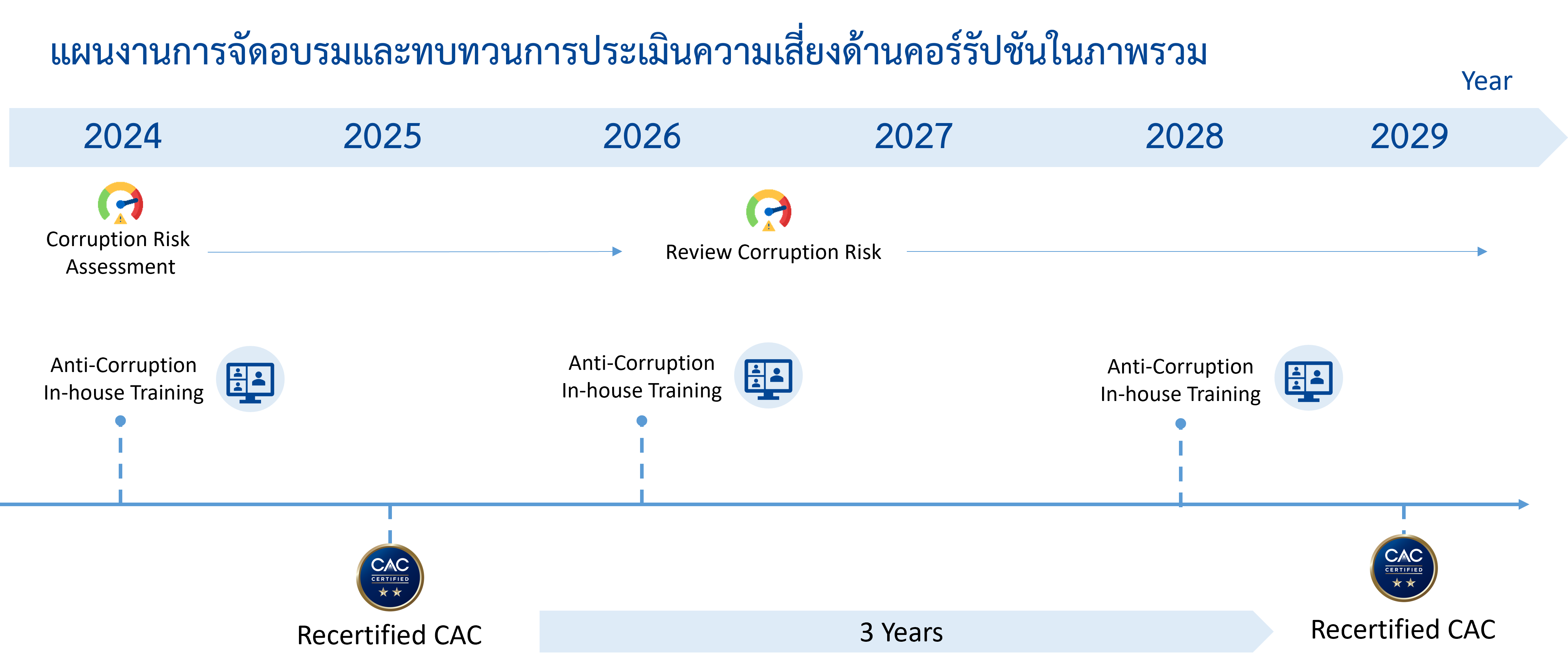
Form of Anti-Corruption Operations
| Operation |
|---|
| Assessment and identification of corruption risk |
| The participation in anti-corruption projects |
| Communication and training for employees on anti-corruption policy and guidelines |
| Review of the completeness and adequacy of the process by the Audit Committee or auditor |
| Review of appropriateness in anti-corruption |
| The monitoring of the evaluation of compliance with the anti- corruption policy |
Number of Corruption Cases
| Metric | Current Year | Previous Year | Two Years Ago |
|---|---|---|---|
| Total number of cases or issues related to corruption (cases) | 0 | 0 | 0 |
Whistleblowing
Has the Company Implemented Whistleblowing Procedures?
Yes
Operations in the Past Year
The company provides channels for inquiring about additional information regarding ethics and business conduct or operations in accordance with the Whistle Blowing Policy for all stakeholders in inquiring about ethics and business conduct, and complaining or reporting clues of suspected violations or non-compliance with laws, regulations, fraud, corruption, including measures to protect whistleblowers or complainants in order to promote reporting of problem solving in case of finding irregularities that may be considered misconduct. The company has communicated such policies to external parties and employees as follows:
Internal Channels for Employees | Complaint Channels for External Parties |
Complaint channels through the company for employees, shareholders, customers, business partners or other
|
|
The company also reports the results of compliance with ethics and business conduct and/or when receiving clues from such channels to the Board of Directors on a regular basis every year. In 2025, there were no whistleblowers or complaints regarding illegal, ethical and business conduct, and corruption to the company.
Number of Whistleblowing Cases
| Metric | Current Year | Previous Year | Two Years Ago |
|---|---|---|---|
| Total number of cases or issues received through whistleblowing channels (cases) | 0 | 0 | 0 |
Selection of Directors & Chief Executives
Directors & Chief Executives — Introduction
The Nomination and Remuneration Committee is responsible for recruiting qualified people in accordance with the Company's business strategy to serve as directors and members of sub-committees based on their knowledge, competence, expertise and previous work experiences, which can fulfill the requirements of the vacancies. The Board Skill Matrix is used as a tool to evaluate the qualifications of all directors in the consideration, including the independence of the directors in case of the nomination of independent directors, which the Company shall verify the eligibility of the nominated persons that it does not contravene the applicable law. The Nomination and Remuneration Committee shall review the list of eligible persons from the Director Pool of the Thai Institute of Directors Association, from nominations by individual directors, from the directors who have accepted the extended term, and from the nominations by shareholders who have been scrutinized as qualified by applicable laws and relevant criteria (if any) in order to present to the Board of Directors. After the Board of Directors has approved the nominated directors, the Company will conduct discussions and requests for approval from the Office of the Insurance Commission (OIC) before presenting to the shareholders' meeting (depending on the case) for further appointment.
Are Directors Selected Through the Nomination Committee?
Yes
Are Chief Executives Selected Through the Nomination Committee?
Yes
Directors from Major Shareholders — Introduction
The Company has one director representing a major shareholder, namely Mr. Oran Vongsuraphichet, representing Thai Reinsurance Public Company Limited, which is a major shareholder of the Company.
Number of Directors from Major Shareholders
1
Rights of Minority Shareholders on Director Appointment
The Company recognizes the importance of treating all shareholders fairly and equitably in order to promote the principles of good corporate governance. Accordingly, the Company provides minority shareholders with the opportunity to propose qualified candidates for election as directors in advance of the Annual General Meeting of Shareholders, which is normally held in April each year. The criteria and procedures for such nomination are established by the Company and publicly disclosed on the Company’s website.
Method of Director Appointment
| Method |
|---|
| Method whereby each director requires approval votes more than half of the votes of attending shareholders with voting rights |
Selection of Independent Directors
Criteria for Selecting Independent Directors
The Company sets out criteria for selection process of independent directors. A candidate must meet the qualifications for director nomination of the Company as well as the qualifications of ‘Independent Director’ as defined by the SEC, SET and OIC, these qualifications are as follows;
Definition of Independent Director
“Independent Director” of the Company means a person who possesses the complete qualifications and has the minimum independency as required under the Notification of the Board of Governors of the Stock Exchange of Thailand and Office of Insurance Commission as follows:
An independent director must not hold more than 1 percent of the total number of shares with voting rights of the Company, parent company, subsidiaries, associated companies or any other juristic persons who may have a conflict of interest, inclusive of number of shares held by his/her related persons.
An independent director must not be a director who takes part in management, an employee, a staff member or an advisor who receives a regular salary, or a controlling person of the Company, parent company, subsidiaries, associated companies or subsidiaries of the same rank or juristic persons who may have a conflict of interest, unless the foregoing relationship already ended for at least two years before the date of appointment as the Company’s independent director.
An independent director must not have relationship, whether by blood or by legal registration, in the form of fatherhood, motherhood, spouse, sibling and child as well as child’s spouse of the executives, major shareholders, controlling persons or persons to be nominated as executives or controlling persons of the Company or its subsidiaries.
An independent director must not have nor have ever had a business relationship with the Company, its parent company, subsidiary, associate, major shareholder or controlling person, in a manner that may interfere with his/her independent judgment, and neither is nor has ever been a significant shareholder or controlling person of any person having a business relationship with the Company, its parent company, subsidiary, associate, major shareholder or controlling person, unless the foregoing relationship has ended not less than 2 years prior to the date of becoming an independent director.
The term ‘business relationship’ in the preceding paragraph shall include any normal business transaction, rental or lease of immovable property, transaction relating to assets or services or granting or receipt of financial assistance through receiving or extending loans, guarantees, providing assets as collateral, and any other similar actions, which result in the applicant or his/her counterparty being subject to indebtedness payable to the other party in the amount of 3% or more of the net tangible assets of the applicant or twenty million baht or more.
An independent director must not be or have been an auditor of the Company, parent company, subsidiaries, associated companies or juristic persons who may have a conflict of interest, and must not be a major shareholder, non-independent director, executive or managing partner of an audit firm which employs auditors of the Company, parent company, subsidiaries, associated companies or juristic persons who may have a conflict of interest, unless the foregoing relationship already ended for at least two years before the date of appointment as the Company’s independent director.
An independent director must not be or have been a professional advisor including legal advisor or financial advisor who receives an annual service fee exceeding THB 2 million from the Company, parent company, subsidiaries, associated companies or juristic persons who may have a conflict of interest, and, in case the professional advisor is a juristic person, must not be or have been a major shareholder, non-independent director, executive or managing partner of the professional advisor, unless the foregoing relationship already ended for at least two years before the date of appointment as the Company’s independent director.
An independent director must not be appointed as a representative of the Company’s director, major shareholder or shareholders who are related to the Company’s major shareholder.
An independent director must not undertake any business in the same nature and in competition with the business of the Company or its subsidiary, nor be a significant partner in a partnership or director with management authority, employee, staff member or advisor who receives salary or holds shares exceeding 1% f the total number of shares with voting rights of another company which undertakes business in the same nature and in competition with the business of the Company or its subsidiary.
An independent director must not have any other characteristics which make him/her incapable of expressing independent opinions with regard to the Company’s business affairs.
After being appointed an independent director possessing the characteristics as defined in the first paragraph, the independent directors may be assigned by the Board of Directors to make a collective decision on any activities of the Company, parent company, subsidiary companies, associated companies, subsidiary companies of the same rank, major shareholders or persons with control power in the Company.
In the case where the person appointed by the Company as an independent director has or used to have business relationship or provides or used to provide professional service in the amount exceeding the value specified in Clause 4. or Clause 6., the Company shall be granted a waiver of the prohibition from such business relationship or professional service which exceeds the specified value after the Company 1) has sought the Board of Directors’ opinion which is expressed in such a way that the appointment of such person has no impact on the discharge of his/her duty and the rendering of his/her independent opinion, and 2) has disclosed the following information in the notice of the shareholders’ meeting on the agenda item regarding the consideration and appointment of independent directors:
(1) Nature of the business relationship or professional service which causes such person to fail to meet the specified qualifications;
(2) Reasons and necessity to allow such person to remain or be appointed as the independent director; and
(3) The Board of Directors’ pinion on the nomination of such person for appointment as the independent director.
The Board of Directors has considered, with due care, that all independent directors fully meet the qualifications set forth by the Company and their resuming in such position for several consecutive terms does not have any impact on the discharge of their duty and provision of independent opinions.
Director of the Audit Committee who retire by rotation may be re-appointed. In the event that the position of the Audit Committee is vacant due to any reason other than the expiration of the term The Board of Directors shall appoint a fully qualified person to be a member of the Audit Committee so that the number of members of the Audit Committee can be met as specified by the Board of Directors. The person who is a replacement audit committee member will be in office only for the remaining term of the audit committee member he replaces. That is, when the number of Audit Committee members becomes less than three, the Board of Directors or the shareholders' meeting shall appoint the full number within no more than three months from the date on which the Audit Committee's number is less than three person.
The Board of Directors has carefully considered and views that all independent directors are fully qualified as specified by the Company and that they hold office for many consecutive terms. It has no effect on the performance of duties and giving independent opinions.
Did Any Independent Director Have a Business or Professional Relationship?
No
Director Development
Director Development — Introduction
The Board of Directors has always given importance to the development of directors. It has a policy to encourage directors to continually develop their knowledge and to attend development, training, attend seminars or exchange learning between directors (peer learning) in order to increase their knowledge in various fields related to their roles and responsibilities. Assigned both as directors and committees of various sub-committees to keep abreast of changes in business environment, such as Corporate governance, information technology, and sustainable development both organized by the Stock Exchange of Thailand, the Securities and Exchange Commission, Thai Institute of Directors Association, Office of Insurance Commission, Including other agencies and organizations. The company regularly informs directors of training courses or seminar activities.
Development of Directors in the Past Year
The directors’ professional development activities in 2025 are summarized as follows:
Name of Director | Course/Subject | Organizer |
|
|
|
|
|
|
|
|
|
|
|
|
Currently, there are 7 and 3 directors who have been trained in the courses about Director Certification Program (DCP) and Director Accreditation Program (DAP) of IOD, respectively, from the total of 8 directors, or accounted for 90.00%.
In this regard, details about training of the Board members appear in Attachment 1, “Details about Directors, Executives, Authorized Personnel and the Secretary of the Company”
Qualifications for Director Selection — Introduction
The guidelines for nomination and selection of directors in accordance with the Company's strategy and business operations, the Nomination and Remuneration Committee has defined individual requirements for each director and the expertise required for the Board of Directors that can be divided into 3 groups: (1) knowledge, expertise or experience in management from macro perspectives, (2) knowledge, expertise or specialized experience in the insurance business, and (3) knowledge, expertise or other experience that will benefit the Board's duties. In addition, the Nomination and Remuneration Committee shall review the Board Skill Matrix to be appropriate and up-to-date for effective consideration of new director nomination.
In order to recruit, select and appoint directors and senior executives, as well as oversee the establishment of policies, guidelines and procedures for the nomination of directors and senior executives of the Company as mentioned above, the Board of Directors, the Nomination and Remuneration Committee, and executives of the relevant companies have acted without discrimination on racial differences, religion, gender, marital status or physical fitness impairment.
Qualifications for Director Selection
| Qualification | Skill & Expertise |
|---|---|
| Macro perspectives | 112 · Description: Economics · 118 · Description: Banking · 119 · Description: Finance & Securities · 133 · Description: Commerce · 144 · Description: Finance |
| Insurance business | 120 · Description: Insurance · 141 · Description: Law · 142 · Description: Marketing · 150 · Description: IT Management · 165 · Description: Risk Management |
| Other experience that will benefit the Board's duties. | 143 · Description: Accounting · 153 · Description: Statistics · 164 · Description: Strategic Management · 265 · Description: Governance/ Compliance · 1683 · Description: Business Administration |
Evaluation of Board & Subcommittee Performance
Criteria for Evaluating Board Performance
Self-assessment by the Board of Directors and sub committees
Annually, each member of the board is required to evaluate the overall performance of the Board of Directors. The purpose of this is to jointly review performance, problems and obstacles in the past year. The result will be used as a guideline to improve the work of the Board of Directors to ensure greater effectiveness and efficiency. The assessment is divided into 3 categories;
Evaluation for the whole Board of Directors
Self-evaluation of all sub-committees, and
Self-evaluation for individual directors
Evaluation of Board Performance in the Past Year
In 2025, the Company adopted the Board Toolkit of the Thai Institute of Directors (IOD), which was adopted and applied in conjunction with the existing assessment forms of Corporate Governance Center, the Stock Exchange of Thailand to become more complete guidelines for the improvement of directors’ performances according to the good corporate governance in order to properly correspond with the changing business environment and criteria in each period, which were responded by all directors, with the assessment process as follows:
The Company Secretary prepares and reviews the evaluation form to ensure it is efficient, correct and complete according to the regulatory body’s practice guideline.
The Board of Directors conducts the performance evaluation at least once a year.
The Company Secretary concludes and proposes the evaluation results to the Board of Directors’ meeting so as to draw up a guideline on development and improvement of operational efficiency.
The scoring system is divided into five levels as follows:
Average Scores | Meaning |
0.00 – 0.80 | To Be Improved |
0.81 – 1.60 | Fair |
1.61 – 2.40 | Good |
2.41 – 3.20 | Very Good |
3.21 – 4.00 | Excellent |
Performance Evaluation of the Board of Directors as a Whole
All of Board of Directors ‘self-assessments are also carried out on six topics: (1) structure and qualification of the board of directors, (2) role, duties and responsibilities of the board of directors, (3) board meeting, (4) performance of directors, (5) relation with the management, and (6) self – development of directors and development of executives.
Self - evaluation for individual directors
Self-assessment forms of each member of the Board were divided into 5 matters: (1) personal qualifications, (2) availability to perform the duties, (3) meeting participations, (4) roles, duties and responsibilities, (5) relationship with the Board and the management. The performance evaluation of the Board of Directors as a whole in 2025 showed that the Board of Directors could perform their duties in accordance with the principles of corporate governance, achieving an overall average score of 3.88 Meanwhile, the performance evaluation of the individual directors (self-assessment) resulted in an overall average score of 3.89
Performance Evaluation of Sub-committees as a Whole
The Board of Directors also conducts performance evaluation of all board-level committees, which are the Audit Committee, the Enterprise Risk Management Committee, the Nominating and Remuneration Committee and the Investment Committee. Carried out once a year, the said performance evaluation covers the following topics: (1) committee structure and qualifications, (2) committee meeting, (3) roles, duties and responsibilities of the committee, and (4) reporting of the committee. The scoring system is divided into five levels similar to the performance evaluation of the Board of Directors.
The evaluation results of the Audit Committee, the Enterprise Risk Management Committee, the Nominating and Remuneration Committee and the Investment Committee were “Excellent,” with average scores of 3.88, 3.92, 3.65 and 3.93 respectively.
Evaluation Results
| Evaluated Body | Group — Carried Out? | Group — Grade / Average Score | Group — Grade / Full Score | Individual (Self-Assessment) — Carried Out? | Individual (Self-Assessment) — Grade / Average Score | Individual (Self-Assessment) — Grade / Full Score | Cross (Assessing Other Directors) — Carried Out? |
|---|---|---|---|---|---|---|---|
| Board Of Director | Y | 3.88 | 4 | Y | 3.89 | 4 | N |
| Audit Committee | Y | 3.88 | 4 | N | N | ||
| Other Subcommittee | Y | 3.92 | 4 | N | N | ||
| Other Subcommittee | Y | 3.65 | 4 | N | N | ||
| Other Subcommittee | Y | 3.93 | 4 | N | N |
Subcommittees
Subcommittees
| Results of the Subcommittee's Duty Performance |
|---|
In 2025, the Enterprise Risk Management Committee consisted of six directors. Dr. Sutee Mokkhavesa, Independent Director, served as Chairman of the Enterprise Risk Management Committee; Mrs. Komkai Thusaranon, Independent Director, served as a Enterprise Risk Management Committee Director; and Mr. Tarate Poshyananda, Independent Director, served as a Enterprise Risk Management Committee Director. In addition, three top management representatives also served as Enterprise Risk Management Committee Directors, namely Mr. Vipon Vorasowharid, Ms. Navadee Ruangrattanametee, and Mrs. Nutchakorn Suwansathit. The director who served on the Enterprise Risk Management Committee during the year also included Mr. Sutti Rajitrangson (served as a Enterprise Risk Management Committee Director from 21 August 2018 to 11 November 2025). The Enterprise Risk Management Committee performs its primary responsibilities in accordance with the Company’s Enterprise Risk Management Committee Charter. Over the past year, declining interest rates and rising medical inflation posed key risk factors that affected the operating performance and the capital adequacy ratio of life insurance companies. Nevertheless, the Enterprise Risk Management Committee recognized the potential impacts of such risks and closely monitored the Company’s risk positions in order to effectively respond to potential risk events. During the past year, the Committee carried out the following key activities:
|
In 2025, the Nomination and Remuneration Committee consisted of three Directors. Ms. Kittiya Todhanakasem, Independent Director, served as Chairperson of the Nomination and Remuneration Committee; Mrs. Komkai Thusaranon, Independent Director, served as a director of the Nomination and Remuneration Committee; and Mr. Sutti Rajitrangson served as a Director of the Nomination and Remuneration Committee (appointed on 11 November 2025). Directors who served on the Nomination and Remuneration Committee during the year also included Mr. Oran Vongsuraphichet (served as a director of the Nomination and Remuneration Committee from 31 May 2023 to 9 May 2025) and Mrs. Kesara Manchusree (served as a director of the Nomination and Remuneration Committee from 9 May 2025 to 2 September 2025). The Nomination and Remuneration Committee performed its duties as assigned by the Board of Directors with prudence, transparency, and fairness, while taking into consideration the best interests of shareholders and stakeholders. In 2025, the Nomination and Remuneration Committee held a total of two meetings. Key activities were summarized as follows:
|
In 2025, the Investment Committee consisted of three directors. Mr. Tarate Poshyananda, Independent Director, served as Chairman of the Investment Committee; Dr. Sutee Mokkhavesa, Independent Director, served as an Investment Committee Director; and Mr. Vipon Vorasowharid, Managing Director, served as an Investment Committee Director (appointed on 11 November 2025). Directors who served on the Investment Committee during the year also included Mr. Sutti Rajitrangson (served as an Investment Committee Director from 25 February 2014 to 11 November 2025) and Mrs. Kesara Manchusree (served as an Investment Committee Director from 9 May 2025 to 2 September 2025). The Committee’s primary roles and responsibilities were carried out in accordance with the provisions set forth in the Investment Committee Charter. In the past year, the insurance business continued to face heightened economic volatility. The Thai economy remained in a fragile recovery phase amid ongoing global economic and financial uncertainty. Key pressures stemmed from the monetary policy stance of major economies, particularly the United States. Although policy interest rates began to enter an easing cycle in the second half of the year, long-term interest rates remained at elevated levels, resulting in capital outflows from emerging capital markets, including Thailand. At the same time, Thailand’s economic recovery remained sluggish due to weak domestic demand, high household debt levels, and cautious private sector investment. The export sector faced additional pressure from slowing global demand, as well as the impact of trade protection measures imposed by the United States. Periodic appreciation of the Thai baht further exerted pressure on revenues and profit margins of listed companies. Consequently, capital market conditions remained volatile. Against this backdrop, investment strategies were required to be implemented with prudence, with an emphasis on risk management and selective investment in assets with strong financial fundamentals and resilience to uncertainty. Accordingly, the Investment Committee’s operations in 2025 focused on the following key priorities.
|
Meeting Attendance & Remuneration
Meeting Attendance — Introduction
The Company has set the meeting date and agenda for the regular meeting of the Board of Directors in advance each year. The Company Secretary will inform the date and time of the meeting. Including the annual agenda for the whole year's meeting to be informed to the directors in advance. Since the end of the year before the next year's meeting so that directors can allocate time and attend meetings Generally, the Board of Directors' meeting is held on the second Monday of the month in which the meeting is held and may be changed or scheduled for additional Board meetings as appropriate.
In 2025, there were total of 6 board meetings, which were at least 4 pre-scheduled meetings annually (every 3 months) and 2 special meetings, Also, there were two internal meeting among non-executive directors held on February 24, 2025 to discuss the performance criteria for top management for 2025 and to evaluate the performance of top management for 2024. as physical meeting and electronic meetings. The attendance of entire Board of Directors is accounted for 95%, and, each director has attended more than 75% of all meetings, as required by the Board of Directors for its meetings each year that there should be an average of director’s attendance of at least 75% of the year-round meetings. In case that any director is necessarily unable to attend any meeting of the Board of Directors, the director shall inform the Chairman of such necessity at the first opportunity and before that meeting.
However, during each Board meeting, the Company shall send a meeting invitation along with meeting documents to all directors at least 7 business days prior to the meeting, unless in case of necessity for urgent meeting to preserve the rights or benefits of the Company, so that the directors have sufficient time to study the information and exclude meeting documents of confidential agenda opted out of discussion in the meeting. Additionally, if directors require further information, request can be made by contacting the Company’s secretary.
In every meeting, the Company shall arrange for executives and relevant parties to participate in the meeting in order to present details in the agendas of their concerns so the directors can make the right and timely decisions. In addition, during voting procedures, there must be at least two-thirds of the total number of directors present at the meeting, which is in accordance with good corporate governance principles.
Furthermore, consent agendas are also clearly defined stated as a matter for acknowledgment, approval, or consideration. e.g. the approval of financial statements that have been reviewed or audited by the auditor, etc. For other agendas, Chairman of the Board and Managing Director shall jointly consider due to the importance and necessity. In case that the Company does not hold a meeting every month, the Company shall prepare a report of performances and present it to the Board of Directors every month so that the Board of Directors can govern, control and monitor the management's operations continuously.
Meeting Attendance — Remark
Remuneration — Introduction
Remuneration for the Board of Directors and Top Management
The Board of Directors has appropriately considered the remuneration for the directors, sub-committee and senior management for the duties, responsibilities and participation of each director. And can compare with other businesses in the same industry or similar to the company. The Board of Directors assigns the Nomination and Remuneration Committee responsible for establishing and reviewing criteria, policies, and forms of consideration for compensation or other benefits to the Board of Directors and all sub-committees for submission to the Board of Directors for approval before proposing to the shareholders' meeting for consideration and approval annually.
The Board of Directors does not have any other remuneration or welfare other than meeting fee and gratuity.
Types of Remuneration of the Board of Directors
The directors’ remuneration structure comprises two components: annual bonus and meeting allowance for directors and members of sub-committees who attend meetings. The Nomination and Remuneration Committee proposes the remuneration structure and rates to the Board of Directors for consideration, and subsequently submits them to the Annual General Meeting of Shareholders for approval as follows:
Board of Directors | Attendance fee per session, (per person)* | Gratuity (per person) | ||
Chairman | Vice Chairman | Director | ||
Board of Directors | 40,000 | 35,000 | 30,000 | -None- |
Audit Committee | 40,000 | -None- | 30,000 | -None- |
The Remuneration and Nominating Committee | 30,000 | -None- | 30,000 | -None- |
Investment Committee | 30,000 | -None- | 30,000 | -None- |
Enterprise Risk Management Committee** | 40,000 | -None- | 30,000 | -None- |
Remark
*Meeting allowance per person was paid to only the attendees of the meeting.
**Attendance fee for the enterprise risk management committee except for executive directors because they are already in the position of executive of the company.
Remuneration of the Board of Directors
Remuneration or Benefits Payable to the Board
| Metric | Amount (Baht) |
|---|---|
| Remunerations or benefits pending payment to the board of directors over the past year (baht) | 0 |
Supervision of Subsidiaries & Associated Companies
Does the Company Have Subsidiaries or Associated Companies?
Yes
Is There a Mechanism for Overseeing Subsidiaries and Associated Companies?
Yes
Mechanism for Overseeing Management of Subsidiaries
Under the Company’s mechanism for monitoring of its associated companies, the Board of Directors and/r the management are responsible for nominating and voting on appointment of the Company’s directors and/r executives to serve as directors of the associated companies. The appointed persons shall be obligated to perform duties in the best interest of the associated companies that they serve. Number of director seats in the associated companies to which the Company is entitled is allocated according to the Company’s shareholding percentage in any such entities or as agreed upon in the shareholders’ agreement.
Oversight Mechanisms
| Mechanism |
|---|
| Sending representatives to act as directors, executives or controlling persons in proportion to shareholdings |
Agreements Between the Company and Shareholders in Managing Subsidiaries
The Company has no agreement with other shareholders regarding the management of the associated companies.
Audit Committee Duty Performance
Results of the Audit Committee's Duty Performance in the Past Year
The report on the performance of the Audit Committee for the year 2025 is provided in Attachment 6: Audit Committee Report.