

MD&A · 2025
In this section4 topics
Overview of Operations
Overview of Operations
Overview of the Thailand’s Life Insurance Industry
In 2025 there is another period of significant challenges for the life insurance industry, as it continued to operate under a highly volatile environment. Key headwinds included a domestic economic slowdown, rising medical inflation, and a downward interest rate trend. Amidst these complexities, Thaire Life Assurance Public Company Limited remains steadfast in its vision of being a specialized life reinsurance partner. We are committed to developing innovative products and services that deliver sustainable value to our customers, the economy, and society.
Regarding the industry outlook, the total gross written premiums for Thailand's life insurance business in 2025 of THB 676,505 million, representing a growth rate of 3.45%. This growth is primarily driven by the country's aging demographics and a heightened public awareness of long-term financial planning and healthcare, leading to higher demand for health insurance products. Furthermore, life insurers have successfully leveraged agency, brokerage, and online channels, while integrating Artificial Intelligence (AI) to enhance communication and service efficiency, allowing for more effective customer base expansion.
Despite these opportunities, the sector continues to face pressure from economic uncertainty, which has impacted consumer purchasing power leading to delayed decisions or a shift toward lower-premium plans. Additionally, the mandatory implementation of TFRS 17 in 2025 has required companies to refine their revenue and profit reporting frameworks and adopt more cautious product design strategies. Simultaneously, the declining interest rate has reduced the appeal of high-yield products, resulting in slowing the growth of new business premiums.
Overview of the company's operations
In terms of underwriting, the Company remained committed to implementing robust strategies to mitigate multifaceted impacts and adapt to industry shifts. Our approach focused on rebalancing high-risk product portfolios, refining reinsurance terms and conditions, and proactively seeking new opportunities across products, services, markets, and strategic partnerships. The Company continues to drive its marketing policy by prioritizing the co-creation of products and services with our life insurance partners. Our goal is to deliver solutions that precisely address market demands and consumer needs, particularly in response to shifting demographic structures and evolving medical treatment patterns. We emphasize an end-to-end product development process, encompassing targeted product design, comprehensive market testing, and the establishment of clear sales strategies and distribution procedures to ensure the effective achievement of our business objectives.
In terms of investment management, the Company aims to allocate its investment portfolio in alignment with liabilities arising from insurance contracts, under an investment policy framework that emphasizes asset suitability and adequate returns. The Company adheres to a prudent investment approach, with a strong focus on the quality and stability of securities, to safeguard its financial position and long-term operating performance. Simultaneously, we actively rebalance our investment portfolio in response to shifting market conditions to ensure consistent returns, while remaining firmly committed to the principles of the Investment Governance Code (I Code), enhancing credibility and fostering long-term confidence among all stakeholders.
The Company places great importance on continuous risk and capital management. We maintain a disciplined approach to managing our reinsurance portfolio while ensuring capital levels are resilient to economic fluctuations and regulatory requirements. Our internal policy mandates a Capital Adequacy Ratio (CAR) of no less than 300%. This benchmark is equivalent to the standards applied by the Office of Insurance Commission (OIC) for international reinsurers with a "AAA" credit rating. Consequently, the Company maintains the lowest level of credit risk, further strengthening our competitive advantage in the reinsurance market.
As a result of operating under a policy of stable and sustainable growth, with due consideration given to economic, social, and environmental dimensions, alongside strong corporate governance principles, the Company was recognized this year as a “Sustainable Stock” with a SET ESG Rating of A by the Stock Exchange of Thailand for the fourth consecutive year. In addition, the Company received an Excellent Corporate Governance (CG) Rating of 5 Stars for the ninth consecutive year and was ranked among the Top Quartile Companies based on the Corporate Governance Report (CGR) survey conducted by the Thai Institute of Directors (IOD) for the third consecutive year.
Beyond governance and sustainability, the Company was honored with the Outstanding Investor Relations Award at the SET Awards 2025. This recognition reflects our unwavering commitment to transparent, comprehensive, and efficient communication with the investment community. Additionally, we received a certificate from the ESG DNA Program by the Stock Exchange of Thailand, underscoring our success in embedding sustainability into our corporate culture at all levels.
Operating Results & Financial Condition
Operating Results & Profitability
2025 | 2024 | Change | ||
THB Million | THB Million | THB Million | Percent | |
Insurance revenue | 2,539 | 2,676 | (137) | -5% |
Insurance service expenses | (2,476) | (3,366) | 890 | -26% |
Net income (expenses) from reinsurance contracts held | (59) | 50 | (109) | -218% |
Insurance service result | 5 | (640) | 644 | 101% |
Net investment income | 63 | 72 | (9) | -12% |
Net insurance finance expenses | (63) | (59) | (4) | 8% |
Net investment and insurance finance result | (0) | 13 | (13) | -101% |
Other operating expenses and other finance costs | (103) | (102) | (0) | 0% |
Other income | 1 | 1 | (1) | -52% |
Loss before income tax | (98) | (727) | 630 | 87% |
Income tax revenue | 21 | 149 | (128) | -86% |
Net loss | (77) | (579) | 502 | 87% |
Net Combined Ratio | 99.8% | 123.9% | ||
In 2025, the Company adopted Thai Financial Reporting Standard No. 17, Insurance Contracts (TFRS 17), for the first time. The new standard has significantly changed the principles for measurement, revenue recognition, and presentation of insurance contract performance. Under TFRS 17, underwriting profit is recognized over the period in which insurance services are provided through the systematic release of the Contractual Service Margin (CSM), rather than being recognized upfront at policy inception as in the past.
In transitioning to the new standard, the Company complied with the prescribed transition requirements by measuring insurance contracts in force at the date of initial application using approaches consistent with TFRS 17. This resulted in adjustments to the opening balances of equity and the components of insurance contract liabilities to reflect the present value of contractual cash flows, the risk adjustment, and the unearned contractual service margin.
Under TFRS 17, the statement of profit or loss separately presents the insurance service result from net investment income and insurance finance expenses to more appropriately reflect the sources of earnings. The insurance service result reflects performance from the provision of insurance services, including changes in related estimates, while the investment and finance components reflect returns on invested assets and the finance costs associated with measuring insurance liabilities on a present value basis.
For 2025, the Company reported a net loss of Baht 77 million, improved from a net loss of Baht 579 million in the prior year, representing an improvement of Baht 502 million or 87%. This reflects a positive trend in operating performance compared with the previous year, driven by the turnaround of the insurance service result to a positive position, indicating more stable claims experience and the gradual recognition of contractual service margin. However, the insurance service result was still insufficient to fully absorb the Company’s overall operating expenses.
Based on the presentation structure under TFRS 17, the net loss for the current period was primarily driven by the insurance service result, while the net position between investment income and insurance finance expenses, which was previously profitable, declined to a level close to breakeven in the current year. Other operating expenses remained broadly in line with the prior year. As a result, the change in net results for the period mainly reflects the improvement in underwriting performance, which the Company explains further below.
Insurance service result
The insurance service result represents insurance revenue less insurance service expenses, adjusted for net income (expenses) from reinsurance contracts held. In 2025, the Company’s insurance service result improved significantly by Baht 644 million, turning from an insurance service loss of Baht 640 million in 2024 to a profit of Baht 5 million in 2025. This turnaround was driven by remediation of underperforming legacy portfolios together with improved quality of new business through stricter underwriting discipline, appropriate pricing, and enhanced risk management. The Net Combined Ratio improved to 99.8% in 2025 from 123.9% in 2024.
For insurance service results relating to reinsurance contracts issued by the Company, the components are as follows:
2025 | 2024 | Change | ||
THB Million | THB Million | THB Million | Percent | |
CSM amortisation (recognised insurance service profit) | 464 | 314 | 150 | 48% |
Risk adjustment release recognised in the period | 193 | 172 | 21 | 12% |
Difference between expected and actual claims experience | (313) | (890) | 577 | -65% |
Loss on onerous contracts and reversal of losses | (281) | (286) | 5 | -2% |
Insurance service result – reinsurance contracts issued | 63 | (690) | 753 | 109% |
In 2025, the insurance service result from reinsurance contracts issued recorded a profit of Baht 63 million, compared with a loss of Baht 690 million in the prior year. The improvement was mainly driven by higher CSM amortisation of Baht 464 million, increasing by 48% year-on-year, and risk adjustment release of Baht 193 million, increasing by 12%, in line with the pattern of service provision and risk release during the period.
Meanwhile, the difference between expected and actual claims remained a loss of Baht 313 million; however, this represented a significant improvement from the loss of Baht 890 million in the prior year, or a favorable change of 65%, reflecting reduced volatility in claims experience. The Company also recognized net losses from onerous contracts and reversals of Baht 281 million, decreasing by 2% from the prior year. Overall, the insurance service result improved from both the planned profit emergence and reduced pressure from adverse claims experience compared with the previous year.
Net investment income
2025 | 2024 | Change | ||
THB Million | THB Million | THB Million | Percent | |
Interest income from debt instruments | 40 | 39 | 1 | 3% |
Dividend income from equity instruments | 19 | 34 | (15) | -44% |
Net gain on financial instruments | 1 | 1 | - | 0% |
Gain (loss) on fair value changes | 4 | (1) | 5 | -500% |
Other investment expenses | (1) | (1) | - | 0% |
Net investment income | 63 | 72 | (9) | -13% |
Net investment income comprises interest income, dividend income, net gains on financial instruments, fair value gains (losses), and expected credit losses. In 2025, net investment income totaled Baht 63 million, decreasing by Baht 9 million or 13% from the prior year. The decline was primarily due to lower dividend income, mainly resulting from a reduction in equity investment allocation. Part of the decrease also reflected liquidity management and asset allocation to support core business operations, which reduced the asset base generating dividend income.
Net insurance finance expenses
2025 | 2024 | Change | ||
THB Million | THB Million | THB Million | Percent | |
Finance expenses from insurance contracts issued | (69) | (59) | (10) | 17% |
Finance income from reinsurance contracts held | 6 | 0 | 6 | 1,313% |
Net insurance finance expenses | (63) | (59) | (4) | 8% |
Net insurance finance expenses represent the combined effect of finance expenses on insurance contracts issued and finance income on reinsurance contracts held. These amounts reflect the finance cost of insurance liabilities arising from the accretion of interest using the discount rates determined at initial recognition. This increases the present value of insurance liability components, including the Best Estimate Liability (BEL), Risk Adjustment (RA), and the unearned Contractual Service Margin (CSM).
In 2025, the Company recognized net insurance finance expenses of Baht 63 million, increasing by Baht 4 million or 8% from the prior year. The increase was largely in line with the higher average insurance contract liabilities during the period, while changes in discount rates were not significant. The Company elected to present certain impacts from discount rate changes in Other Comprehensive Income (OCI option), thereby limiting interest rate volatility recognized in profit or loss during the period.
Other operating expenses and other finance costs
2025 | 2024 | Change | ||
THB Million | THB Million | THB Million | Percent | |
Employee expenses | 60 | 63 | (3) | -4% |
Premises and equipment expenses | 20 | 18 | 2 | 10% |
Other operating expenses | 23 | 21 | 2 | 7% |
Other operating expenses and other finance costs | 103 | 102 | 0 | 0% |
Other operating expenses and other finance costs comprise expenses related to overall management and business support functions that are not directly attributable to insurance service provision. Major components include employee expenses, premises and equipment expenses, and other general operating expenses.
In 2025, total other operating expenses and other finance costs amounted to Baht 103 million, broadly in line with the prior year. Employee expenses decreased by Baht 3 million or 4% due to personnel cost management. Premises and equipment expenses increased by Baht 2 million or 10%, and other operating expenses increased by Baht 2 million or 7%, mainly driven by support costs and system-related expenses associated with the adoption of the new accounting standard. Nevertheless, these increases were partly offset by lower employee expenses, resulting in overall operating expenses remaining broadly stable year-on-year.
Analysis of the Company’s Financial Position
2025 | 2024 | |||
THB Million | Percent | THB Million | Percent | |
Assets | ||||
Cash and cash equivalents | 31 | 1% | 37 | 1% |
Insurance contract assets and reinsurance contract assets | 197 | 8% | 222 | 8% |
Financial assets – debt instruments | 1,594 | 67% | 1,898 | 68% |
Financial assets – equity instruments | 196 | 8% | 290 | 10% |
Deferred tax assets | 278 | 12% | 256 | 9% |
Other assets/1 | 76 | 4% | 92 | 4% |
Total assets | 2,372 | 100% | 2,795 | 100% |
Liabilities and equity | ||||
Liabilities | ||||
Insurance contract liabilities | 1,668 | 70% | 2,154 | 77% |
Reinsurance contract liabilities | 169 | 7% | 17 | 1% |
Other liabilities/2 | 34 | 2% | 38 | 1% |
Total liabilities | 1,871 | 79% | 2,209 | 79% |
Equity | ||||
Issued and paid-up share capital | 620 | 26% | 620 | 22% |
Share premium | 79 | 3% | 79 | 3% |
Retained earnings | (117) | -5% | (23) | -1% |
Other components of equity | (81) | -3% | (89) | -3% |
Total equity | 501 | 21% | 587 | 21% |
Total liabilities and equity | 2,372 | 100% | 2,795 | 100% |
/1 Other assets comprise accrued investment income, investment in an associate, leasehold improvements and equipment, intangible assets, and other assets.
/2 Other liabilities comprise lease liabilities, employee benefit obligations, accrued expenses, and other items.
Asset
Financial assets
2025 | 2024 | Change | ||
THB Million | THB Million | THB Million | Percent | |
Cash and cash equivalents | 31 | 37 | (6) | -17% |
Financial assets – debt instruments | ||||
Government and state enterprise securities | 821 | 1,028 | (207) | -20% |
Corporate debt instruments | 664 | 696 | (32) | -5% |
Fixed deposits | 20 | 32 | (12) | -38% |
Unit trust | 89 | 142 | (53) | -37% |
Financial assets – equity instruments | ||||
Domestic equity instruments | 196 | 290 | (94) | -32% |
Total financial assets | 1,821 | 2,225 | (404) | -18% |
As at the end of 2025, the Company’s total financial assets held for investment amounted to Baht 1,821 million, decreasing from Baht 2,225 million in the prior year. The reduction reflects active portfolio sizing in line with insurance contract obligations, liquidity management to support claim payments during the period, and the continued implementation of market risk management strategies.
The investment portfolio remained primarily concentrated in debt instruments, consistent with the Company’s asset management policy that emphasizes cash flow stability and limits fair value volatility from equity instruments. The Company held government debt securities of Baht 821 million, declining broadly in line with the overall portfolio contraction and continuing to serve as key assets supporting insurance contract liabilities. Corporate debt securities decreased slightly in value; however, their proportion increased from 31% to 37%, reflecting a tactical shift toward higher-yield assets (yield enhancement) within an acceptable risk framework and aligned with the strategy to enhance returns in a relatively high interest rate environment.
In addition, the Company reduced its investment in domestic equities from Baht 290 million to Baht 196 million and decreased investment units from Baht 142 million to Baht 89 million. As a result, the overall proportion of risk assets declined significantly. This reduction reflects a prudent view on capital market volatility and the management of fair value volatility risk, which may affect the Company’s operating results and shareholders’ equity.
Liabilities
Insurance contract liabilities
Insurance contract liabilities represent reinsurance contracts issued by the Company. As at the end of 2025, the balance amounted to Baht 1,668 million, representing 89% of total liabilities, compared with Baht 2,154 million, or 98% of total liabilities, as at the end of 2024.
2025 | 2024 | |||
THB Million | Percent | THB Million | Percent | |
Present value of future cash flows | 604 | 36% | 1,214 | 56% |
Risk adjustment | 291 | 18% | 304 | 14% |
Contractual service margin (CSM) | 773 | 46% | 636 | 30% |
Total insurance contract liabilities | 1,668 | 100% | 2,154 | 100% |
As at the end of 2025, the Company’s insurance contract liabilities comprised the present value of future cash outflows of Baht 604 million (36%), risk adjustment of Baht 291 million (18%), and contractual service margin (CSM) of Baht 773 million (46%). In comparison, as at the end of 2024, the balances were Baht 1,214 million (56%), Baht 304 million (14%), and Baht 636 million (30%), respectively.
The risk adjustment represents compensation for uncertainty in the amount and timing of cash flows arising from non-financial risks. The CSM represents unearned profit that will be recognized over the coverage period as insurance services are provided. Both the risk adjustment and the CSM are recognized as insurance revenue in the statement of profit or loss in line with the pattern of services provided over the contract boundary.
As at the end of 2025, the Best Estimate Liability (BEL) decreased compared with the end of 2024, primarily due to the high outstanding claims base in the prior year, which resulted in lower expected future obligations at the current reporting date. Meanwhile, the CSM increased, supported by new business written during the year and favorable changes in estimates related to future service of existing contracts. In accordance with TFRS 17, such impacts are adjusted through the CSM and will be recognized as insurance service revenue in future periods.
Movement in Contractual Service Margin
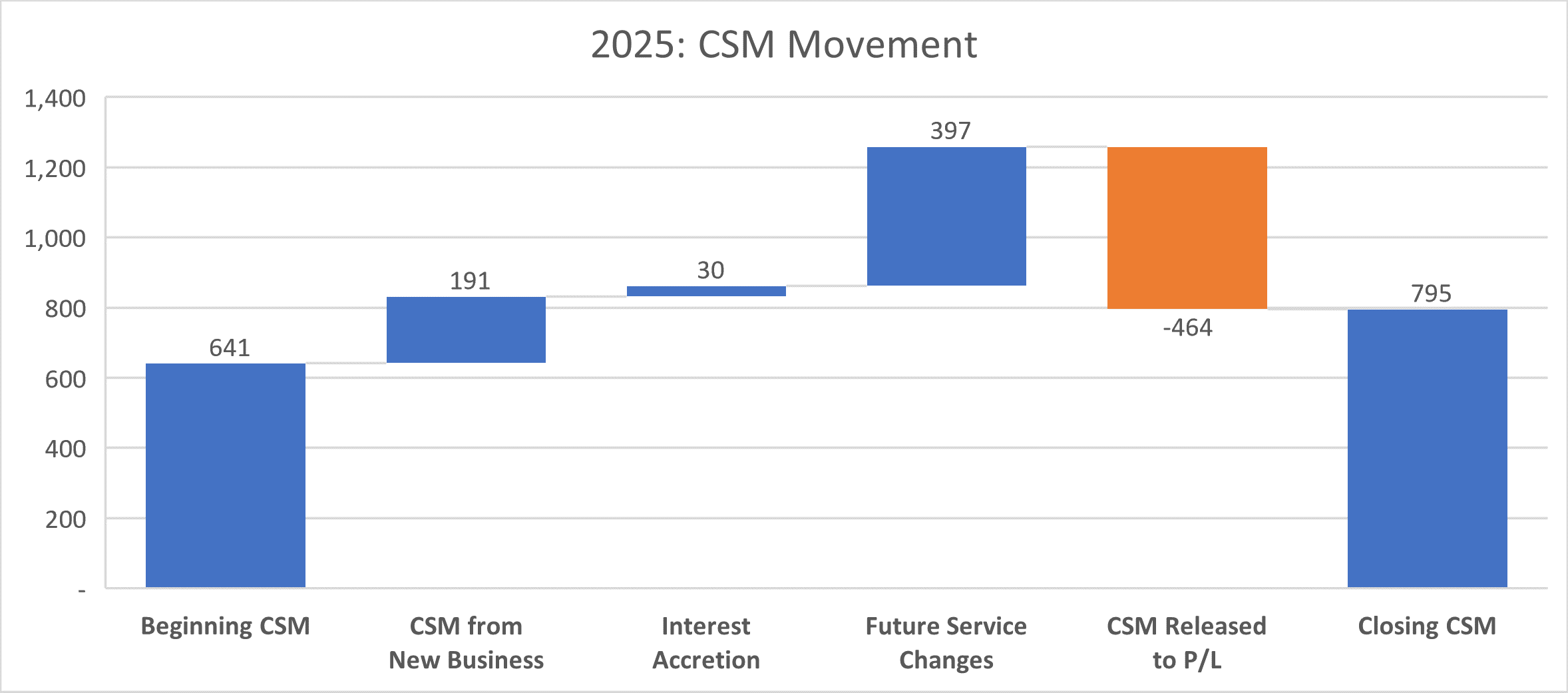
During 2025, the Company reported an opening CSM balance of Baht 641 million. During the year, new contracts contributed Baht 191 million, and interest accretion added Baht 30 million. In addition, favorable operating variances—primarily from actual experience and changes in estimates related to future services—amounted to Baht 397 million, resulting in a balance before revenue recognition of Baht 1,259 million.
In 2025, the Company recognized CSM as insurance revenue of Baht 464 million, an increase of Baht 150 million, or 48%, from the prior year, consistent with the higher level of insurance coverage services provided. Consequently, the closing CSM balance as at the end of 2025 was Baht 795 million, representing a CSM release ratio of 37%.
Equity
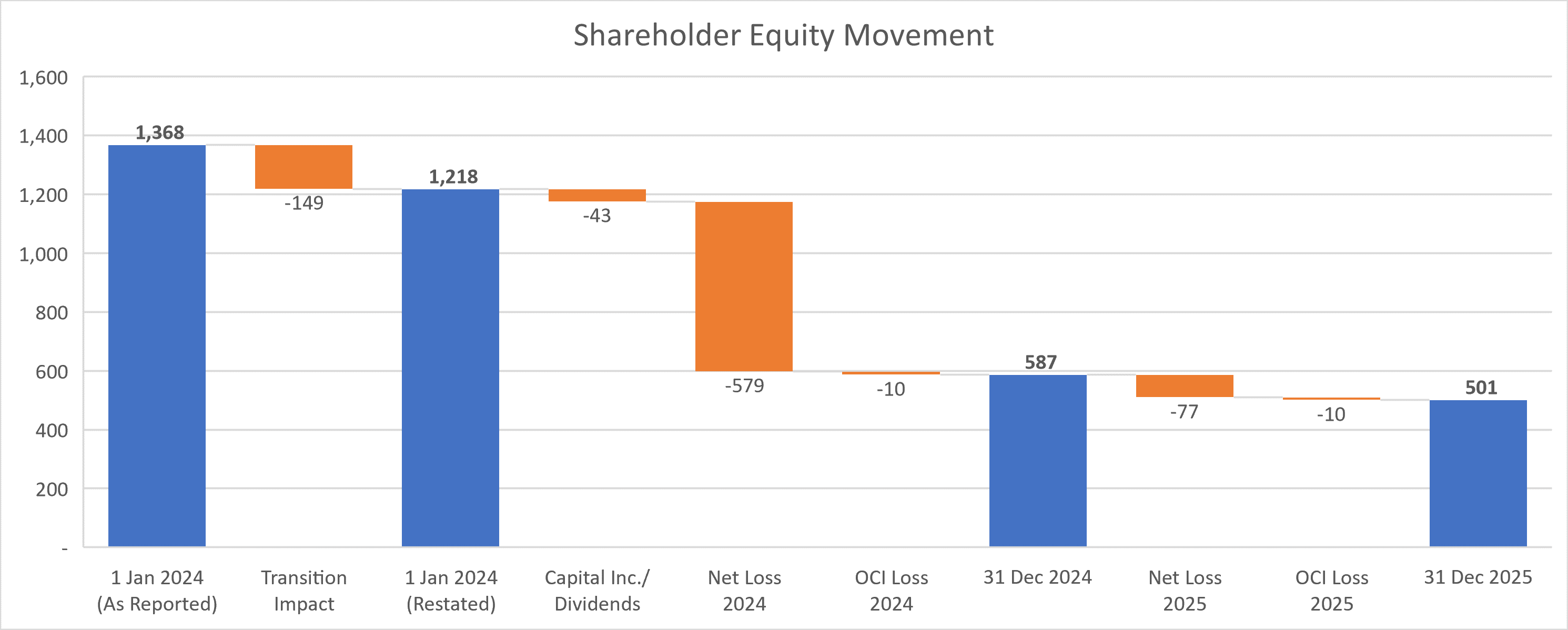
As at 1 January 2024, the Company reported equity of Baht 1,368 million. Upon the first-time adoption of Thai Financial Reporting Standard No. 17: Insurance Contracts (TFRS 17), equity decreased by Baht 149 million to Baht 1,218 million. The adjustment arose from the change in measurement of insurance contract liabilities to fulfilment cash flows, which comprise the Best Estimate Liability (BEL), Risk Adjustment (RA), and Contractual Service Margin (CSM). Under the previous standard, certain profits related to future services may have been recognized or reflected in retained earnings; however, under TFRS 17 such amounts were reclassified to the CSM and presented as part of insurance contract liabilities at the transition date. The resulting measurement difference was adjusted against opening retained earnings, leading to a structural reduction in equity. This impact reflects changes in measurement principles and profit recognition timing and does not represent changes in the Company’s cash flows.
Following the transition to TFRS 17 in 2024, the Company reported a net loss of Baht 579 million. The loss was partly attributable to certain groups of insurance contracts being classified as onerous contracts, experience variances versus assumptions, and updates to future cash flow assumptions for certain portfolios, which affected insurance service results. In addition, equity movements from shareholder transactions included a capital increase of Baht 10 million and dividend payments of Baht 53 million. As a result, equity as at 31 December 2024 was Baht 587 million.
During 2025, equity further decreased due to a net operating loss of Baht 77 million and other comprehensive loss of Baht 10 million. The decline was mainly driven by the net loss for the period, as discussed in the operating results section. Consequently, equity as at 31 December 2025 amounted to Baht 501 million.
Financial Performance and Financial Position Statistics
(Unit: THB Million)
Items | 2025 | 2024* | 2024 | 2023 | 2022 | 2021 | 2020 | 2019 |
TFRS 17 | TFRS 4 | |||||||
Reinsurance premiums written | 4,041 | 4,559 | 4,559 | 3,455 | 2,965 | 2,913 | 2,339 | 2,340 |
Net reinsurance premiums written | 2,883 | 4,375 | 4,375 | 3,426 | 2,931 | 2,891 | 2,319 | 2,324 |
Underwriting profit (loss) | 5 | (639) | (182) | (4) | 105 | 47 | 106 | 126 |
Total investment income/1 | 63 | 70 | 69 | 74 | 76 | 65 | 31 | 100 |
Profit (loss) before Tax | (98) | (727) | (110) | 71 | 182 | 113 | 143 | 232 |
Net profit (loss) | (77) | (579) | (85) | 62 | 153 | 98 | 121 | 194 |
Investment assets | 1,827 | 2,232 | 2,232 | 2,131 | 2,293 | 2,358 | 1,979 | 1,996 |
Total assets | 2,372 | 2,795 | 3,048 | 2,737 | 2,875 | 2,798 | 2,700 | 2,426 |
Total liabilities | 1,871 | 2,209 | 1,806 | 1,369 | 1,429 | 1,328 | 1,276 | 968 |
Paid-up capital | 620 | 620 | 620 | 610 | 600 | 600 | 600 | 600 |
Shareholders’ equity | 501 | 587 | 1,242 | 1,368 | 1,447 | 1,469 | 1,424 | 1,459 |
Contractual service margin | 795 | 641 | n/a | n/a | n/a | n/a | n/a | n/a |
Comprehensive shareholders’ equity/2 | 1,296 | 1,228 | n/a | n/a | n/a | n/a | n/a | n/a |
Per share value and returns | ||||||||
Comprehensive equity per share (Baht) | 2.09 | 1.98 | n/a | n/a | n/a | n/a | n/a | n/a |
Book value per share (Baht) | 0.81 | 0.95 | 2.00 | 2.21 | 2.33 | 2.37 | 2.30 | 2.35 |
Earnings per share (Baht) | (0.12) | (0.93) | (0.14) | 0.10 | 0.25 | 0.16 | 0.20 | 0.31 |
Dividend per share (Baht) | - | - | - | 0.07 | 0.15 | 0.12 | 0.14 | 0.26 |
Stock dividend per share (Baht) | - | - | - | 0.0164 | 0.0167 | - | - | - |
Profitability ratios | ||||||||
Insurance service margin (%) | 0.18 | -23.9 | -4.14 | 0.08 | 3.62 | 2.02 | 4.81 | 6.01 |
Net combined ratio (%) | 99.82 | 123.9 | 104.14 | 99.92 | 96.38 | 97.98 | 95.19 | 93.99 |
Net profit margin (%) | -2.94 | -21.05 | -1.87 | 1.84 | 5.13 | 3.52 | 5.21 | 8.13 |
Return on investment (%) | 3.09 | 3.23 | 3.18 | 3.35 | 3.25 | 2.99 | 1.58 | 5.07 |
Net retention premiums to equity (times) | 5.30 | 4.79 | 3.35 | 2.43 | 2.01 | 2.00 | 1.61 | 1.60 |
Return on equity (%) | -14.08 | -64.10 | -6.49 | 4.41 | 10.50 | 6.81 | 8.43 | 13.41 |
Return on comprehensive equity/3 (%) | -6.07 | -39.38 | n/a | n/a | n/a | n/a | n/a | n/a |
Financial policy ratios | ||||||||
Debt to equity ratio (times) | 3.74 | 3.76 | 1.45 | 1.00 | 0.99 | 0.90 | 0.90 | 0.66 |
Dividend payout ratio (%) | n/a | n/a | n/a | 84.85 | 65.31 | 73.10 | 69.17 | 80.31 |
Capital adequacy ratio (%) | 340.69 | 340.55 | 340.55 | 329.39 | 345.94 | 338.06 | 429.03 | 407.38 |
* Restated/Reclassified in accordance with Thai Financial Reporting Standard No. 17 (TFRS 17): Insurance Contracts
/1 Total Investment Income is defined as Net Investment Income and Share of profit (loss) from investments in associates under the equity method.
/2 Comprehensive shareholders’ equity refers to total shareholders’ equity, including the contractual service margin before tax.
/3 Return on comprehensive equity refers to net profit (loss) divided by the sum of average shareholders’ equity and average contractual service margin before tax.
Note: Book value per share and earnings per share have been adjusted for the number of ordinary shares arising from the stock dividend, as if the stock dividend had been issued from the beginning of the earliest year presented.
Liquidity & Capital Adequacy
The Company maintained an adequate and appropriate level of liquidity to support its operations. Cash flow management and asset allocation were aligned with the timing of obligations arising from insurance contracts under the Asset–Liability Management (ALM) framework. The Company continued to maintain a high proportion of liquid assets and high-quality debt instruments to ensure its ability to meet claim payments and other contractual obligations on an ongoing basis.
In terms of capital adequacy, the Company regularly monitors and manages its capital position in accordance with regulatory requirements. As at year-end 2025, the Company’s Capital Adequacy Ratio (CAR) stood at 340.69%, significantly above the regulatory minimum, reflecting the strength of the Company’s capital base and its capacity to appropriately absorb risks arising from its business operations.
Asset Management Capability
The Company places significant emphasis on aligning asset management with the nature of insurance contract liabilities. The primary objectives are to maintain cash flow stability, generate appropriate risk-adjusted returns, and manage fair value volatility within the Asset–Liability Management (ALM) framework.
During the period, the Company continued to optimize its investment portfolio structure, maintaining a primary allocation to high-quality fixed income instruments to support its ability to meet insurance contractual obligations. At the same time, the proportion of risk assets was managed prudently to reduce sensitivity to capital market volatility and to enhance the stability of operating performance and shareholders’ equity.
Debt Securities with Financial Ratio Requirements
Debt Securities with Financial Ratio Requirements Issued?
No
Factors That May Affect Financial Condition
Factors or Incidents That May Materially Affect Financial Condition
Life Insurance Industry Trend in 2026
Life insurance industry is expected to continue to be stable, with an estimated growth of 2-3 percent, with similar drivers compared to the previous year. Key factors supporting the industry include the following:
1. Retirement trends and an aging society, which continue to drive strong demand for long-term life insurance and savings products.
2. Growth in health insurance, supported by increased public awareness of the importance of health insurance, together with the continued rise in healthcare costs, which encourages consumers to seek coverage that addresses future medical expenses.
3. Growing interest among younger generations in financial planning, with increased demand for products used for wealth transfer and estate planning, in line with long-term wealth management objectives.
4. A strategic shift among life insurers in Thailand, from maximizing premium volume to focusing on Value of New Business (VONB), with greater emphasis on higher-margin products to mitigate risks arising from rising life-related costs and economic volatility.
Nevertheless, 2026 is also expected to present ongoing challenges to business operations. These include global geopolitical tensions, domestic political uncertainty in Thailand, continued economic uncertainty, and the implementation of the new financial reporting standard, TFRS 17. The impact of this standard requires insurers to restructure product offerings and capital management practices to ensure that financial statements more accurately reflect operating performance. This transition represents additional competitive pressure, particularly in terms of internal resource management and portfolio oversight.
In response to prevailing trends and challenges affecting the insurance industry, the Company remains committed to implementing strategies that effectively address ongoing changes. The Company also seeks to identify opportunities to develop new products and services, explore new markets, and establish new strategic partnerships, with the objective of achieving sustainable long-term growth.
The Company aims to manage the reinsurance business to generate strong profits and maintain high-quality reinsurance. This includes developing plans to oversee reinsurance contracts with high loss rates.
The development of health insurance products and services aligns with the policies of the Office of Insurance Commission (OIC). This includes creating new innovations that meet market demands for critical illnesses and the aging society, designing products that cater to the diverse needs of various age groups of policyholders.
Collaborate with partners to manage underwriting results for long-term profitability by developing portfolio management tools to help control loss ratios and improve capital efficiency.
To maintain and strengthen relationships with strategic partners in both the domestic and international markets, including Indonesia, Lao PDR, and Cambodia. In the Indonesian market, the Company has commenced offering Takaful life reinsurance products to address new target customer segments.
Prepare personnel, work processes, and systems to implement the new financial reporting and accounting standards (IFRS17), effective from January 1, 2025.
The Company places great importance on corporate responsibility in building a sustainable business. It also focuses on enhancing the quality of society and the environment, alongside achieving financial objectives. The Company has adopted this concept in its business operations by establishing four sustainability guidelines:
1) Caring for society and the environment
2) Conducting business with ethics
3) Establishing and maintaining financial strength
4) Caring for employees and creating customer satisfaction.
These guidelines are integrated into the business strategies so that it can grow steadily and sustainably while creating value for all stakeholders.